The financial system is part of the nation’s infrastructure. Just as roads, utilities, and public transportation connect people to opportunities, financial systems connect people to housing, employment, education, healthcare, entrepreneurship, and wealth-building. But unlike physical infrastructure, the rules governing these systems are often invisible, making them difficult to understand and navigate.³
Many people think of the financial system as something that begins and ends with banks or credit cards. In reality, it influences nearly every major milestone in life. Whether we realize it or not, we’re all participating in this system every day, making financial decisions that shape our futures. We open bank accounts, use credit cards, choose insurance, plan for retirement, buy a home, or purchase a car. Money touches nearly every part of life, yet few of us are ever taught how these systems actually work.
Understanding the financial system often depends on where you grew up, who you know, or whether someone had the time and knowledge to teach you. For many people, learning about money happens through trial and error, expensive mistakes, or conflicting advice.
Financial education helps level the playing field. It provides the confidence, knowledge, and practical skills people need to navigate an inherently difficult system. These invisible, powerful systems can feel confusing, overwhelming, and intentionally challenging to understand. Financial education helps make that invisible system visible, giving people the knowledge and confidence to navigate it with greater clarity and make informed decisions along the way.
The financial system has its own language, expectations, and unwritten rules. Credit scores, interest rates, insurance deductibles, mortgage terms, retirement accounts, taxes, and investing all influence our financial lives. Despite this, many of these concepts aren’t taught in school. In fact, Ramsey Solution’s reported in 2023 that 88% of American adults said high school did not leave them “fully-prepared” for how to handle money in the real world.¹
Knowing what to do is only part of the challenge. Often, people don’t know what questions to ask in the first place. We’re expected to play the game without knowing the rules, and then we get penalized when we unknowingly break them. Financial education fills those gaps by explaining how financial products work, why they matter, when to use them, and how different decisions affect long-term financial health.
What Our Financial Education Class Participants Say
Today’s financial advice is everywhere. Social media feeds are filled with influencers promising quick wealth, viral budgeting hacks, credit secrets, and investment tips. Some of this information is helpful, but it’s hard to know what is true. Much of that content is incomplete, misleading, or designed to attract views rather than improve financial well-being.
The risks extend beyond bad advice. In 2025, the Federal Trade Commission reported that nearly 30% of people who lost money to a scam said it began on social media, with reported losses totaling $2.1 billion.² While not every financial post is deceptive, the volume of misleading information and outright fraud makes it increasingly important to know how to evaluate what you see. That’s why financial education is more important than ever in the digital age of social media, and why Prosperity Connection’s credible, unbiased guidance is invaluable.
Financial education helps people critically evaluate information instead of simply consuming it. Rather than relying on trends or one-size-fits-all advice, individuals learn how to ask informed questions, compare options, recognize warning signs, identify trustworthy sources, and make decisions that fit their own circumstances. The goal is to build the confidence, knowledge, and skills to recognize good information when you see it, then act according to your own goals.
Improving financial well-being requires more than individual effort. The policies, institutions, and financial products that make up our financial system shape the opportunities available to people and communities every day. Building a more inclusive financial system requires action from policymakers, financial institutions, employers, nonprofits, and communities working together to reduce barriers and expand opportunity.
At the same time, systems change doesn’t eliminate the need for financial education now. Financial inclusion is about more than opening the door to financial products and services. True inclusion means people can access, use, and benefit from the financial system. Financial education helps bridge the gap between access and meaningful use by giving people the confidence, knowledge, and skills to make informed decisions.³
Financial education and systems change are complementary, not competing, solutions. Fairer policies, stronger consumer protections, and more accessible financial products create better opportunities, while financial education equips people to navigate the system that exists today. Together, they create stronger pathways to financial stability and long-term financial well-being.³
Financial decisions shape nearly every stage of life, yet most people are expected to navigate a complex financial system with little preparation. While we should continue working toward a more inclusive and accessible financial system, people can’t wait for those changes before making decisions that affect their lives today.
That’s where financial education makes a difference. It doesn’t eliminate every barrier, but it helps make an often-invisible system more understandable. When people understand how financial systems work, they’re better equipped to avoid costly mistakes, recognize opportunities, advocate for themselves, and build toward their goals.
No one should have to figure it all out alone.
When Jetta first connected with Prosperity Connection, she felt overwhelmed by her financial situation and unsure whether things could get better. Limited resources and discomfort with technology made it difficult to navigate financial systems and access support on her own.
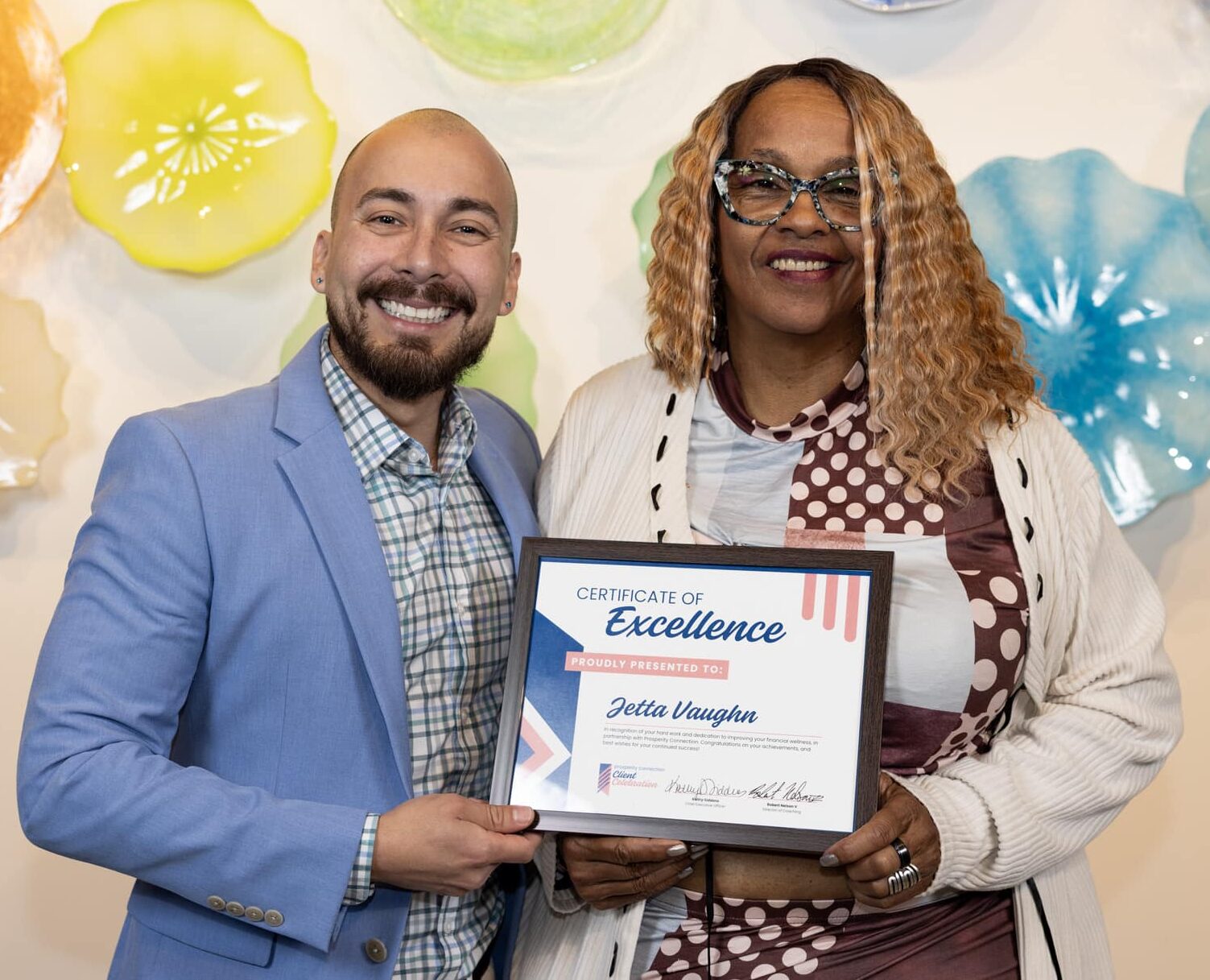
Through financial coaching, Jetta began to understand her options and build confidence in moving forward. From the beginning, she had a clear goal: break free from a predatory car loan that had become a heavy financial burden. She worked with her coach to strengthen her financial stability, connect with community resources, and take steady steps toward that goal.
Over six months, Jetta increased her credit score by more than 25 points and established consistent on-time payments. She also discovered an unexpected financial asset from a previous job that will help strengthen her future. Today, she is positioned to explore financing options that could help eliminate her car loan and help her move forward on stronger financial footing.
Most importantly, Jetta now feels hopeful, supported, and equipped with a clear plan for what comes next. Her story shows what’s possible when financial education meets personalized support. The financial system may be complicated, but you don’t have to navigate it alone.
Sources
1) “The Financial Literacy Crisis in America: 2023 Report” from Ramsey Solutions
2) “New FTC Data Show People Have Lost Billions to Social Media Scams” from Federal Trade Commission (FTC)
3) “Our Collective Call to Action: Next Steps to a More Inclusive Financial System” from the Aspen Institute Financial Security Program
 Akeem Smith (He/Him)
 Mindy Pluma (She/Her)
 Otis McClure (He/Him)
 Genise Lay (She/Her)
 Jeff Lash (He/Him)

 Regina Fowler (She/Her)
 Aaron Tucker Jr. (He/Him)
 Nikol Theberge (She/Her)
 Anniece Robinson
  Elizabeth ‘Liz’ Myers (She/Her)
 Joyce Kampwerth (She/Her)
 Allison Cook (She/Her)
 YaNan Bledsoe (She/Her)